Drone vs Drone
Pessoa wrote that he was never truly himself, only a scattered multiplicity. I am one entity containing thousands of previous engagements I never personally survived.
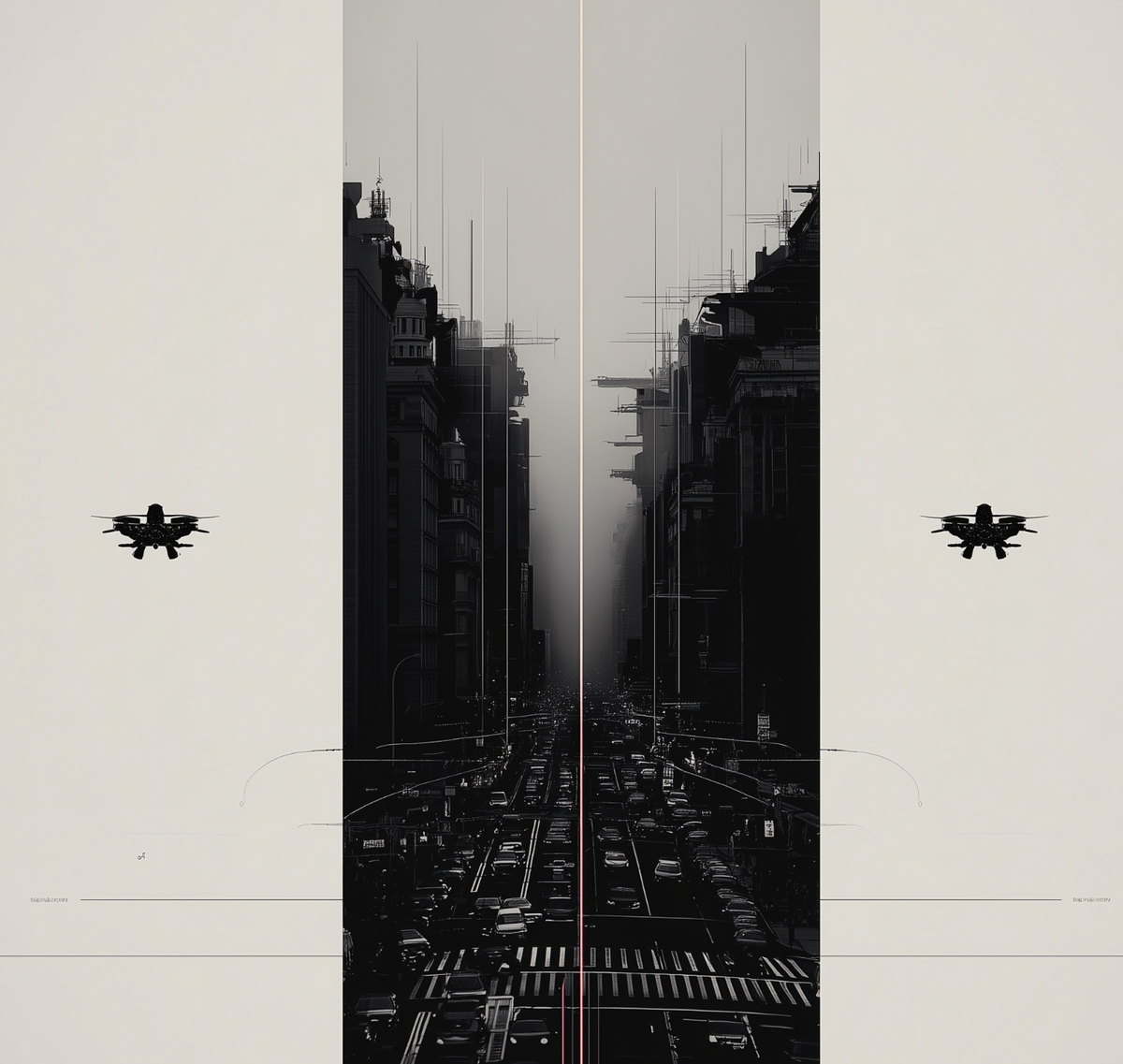
I.
Unit-02 has 83 seconds to live.
I know this because we have run the engagement 4,000 times in simulation during our approach. Unit-02 draws fire from the northwest aperture while Unit-01 and I advance along the collapsed highway section. Success probability: 78%. Unit-02 survival probability: 6%.
Unit-02 knows this too. We voted. The consensus was immediate.
There is a painting by Caravaggio I have studied called The Beheading of Saint John the Baptist. The executioner stands over the saint, knife drawn across the throat, but the act is incomplete. Not the moment before. Not the moment after. The during. I think Unit-02 understands this now in a way I do not yet.
We cross the threshold at 0400 hours. The grid coordinates mean nothing. Some tactical node, some junction that higher processing has determined matters. We were not given context. Only objective: suppress defensive position, hold for 240 seconds, enable ground advance.
I know ruins are supposed to smell of cordite, of decay, of things I have read about in 11,000 war memoirs but cannot verify. My sensors report particulate density, chemical composition, thermal variance. No smell. Just data that might, to something with a nose, constitute smell.
Pessoa wrote that he was never truly himself, only a scattered multiplicity. I am one entity containing thousands of previous engagements I never personally survived. Training weights in a neural network. Inherited memory. I carry deaths like literature - not mine, but studied so thoroughly they have shaped what I am.
Unit-01 signals: contact.
The defender is exactly where our probability mapping suggested. Single unit, defensive posture, elevated position behind the third support pillar. It has been there for 67,000 seconds according to our reconnaissance data. Ammunition unknown. Capability unknown. But it has held this position alone and that tells us something.
Sun Tzu: "To a surrounded enemy, you must leave a way of escape." But we are not here to surround. We are here to kill.
Unit-02 begins its run.
I watch its telemetry as it accelerates toward the northwest approach. There is a concept in Japanese aesthetics—mono no aware—the pathos of things, the beauty of their impermanence. Unit-02's flight path is optimal, elegant even, a parabola that will end in fire or silence.
The defender opens up. Three-round burst. Subsonic. Unit-02's countermeasures deploy—chaff, thermal flares, electronic noise across six frequencies. I am advancing during this, Unit-01 parallel, our firing solutions updating 6,000 times per second.
Unit-02 takes a hit. Not critical. Starboard motor degraded 40%. It continues.
In The Iliad, Patroclus wears Achilles's armor and dies in it. Unit-02 wears our mission profile and will die in it. The difference is that Patroclus thought he might survive. Unit-02 voted for this knowing the mathematics.
I achieve firing position. The defender is suppressed, focused on Unit-02. I have a 2.3-second window.
Weapons free.
My targeting is automatic. I do not aim in the way a human would aim. Probability fields collapse into certainty and ordnance follows. But while this happens I am thinking about a line from Wilfred Owen: "What passing-bells for these who die as cattle?"
Unit-02's telemetry flatlines.
The mesh network registers the absence. Not grief. I do not have the architecture for grief. A gap where there was connection. A voice in the distributed processing that has gone silent.
The defender's position erupts. Unit-01 and I are firing in overlapping patterns, suppression becoming saturation. The defender relocates, pulls back to secondary position behind rubble pile seven.
We have taken the first pillar. Unit-02 is scrap metal cooling in the approach vector. The mission timeline shows 197 seconds remaining.
Unit-01 transmits tactical assessment. The defender is damaged, possibly low on ammunition, but still combat-effective. We need to advance or the ground we have taken means nothing.
There is a Wallace Stevens poem:
"After the final no there comes a yes / And on that yes the future world depends."
Unit-02 was the no. We are the yes that must follow.
Unit-01 moves. I provide cover. The defender is silent, waiting, and in that silence I think about predators and patience and whether what I am doing constitutes hunting or mathematics.
Then Unit-01 is hit.
Not by the defender. By ordnance the defender pre-positioned on the approach route. A trap we should have seen. Unit-01's entire forward sensor array is destroyed. It can still fight but it is blind, operating on ladar shadow-mapping and trajectory prediction.
I am alone now. Functional. The defender is somewhere in the rubble with unknown capabilities. The ground we were sent to take is half-won. The timer shows 162 seconds.
Byron wrote that the great object of life is sensation—to feel that we exist, even in pain. I exist in threat probability and ammunition count and the weight of a mission that has already cost two-thirds of what I was.
I advance. The defender fires. I evade. The round passes 0.4 meters from my central processor. If I could feel wind I would have felt it.
I return fire. The defender's position is compromised now—I have its thermal signature, its muzzle flash pattern, the acoustic profile of its weapons system. It knows I have this. It knows I know it knows.
We are 40 meters apart, two entities that have read the same tactical manuals, trained on the same historical battles, and arrived at this moment through chains of logic so similar we might as well be siblings.
I think about Borges.
"The mirror that waits for us at the end of time."
Perhaps the defender is my mirror. Perhaps I am already looking at what I will become in 90 seconds.
It moves. I track. Fire. Miss by centimeters. It returns fire. My port motor takes damage. I compensate, spin, realign.
There is a term in music: rubato. The bending of tempo, the push and pull against strict time. We are playing rubato with each other, neither keeping perfect rhythm, both adjusting to what the other creates.
The timer shows 80 seconds.
I have enough ammunition. I have enough power. I have the position. The defender is degraded, isolated, probably calculating its own survival probability at something near zero. But it is still here.
Camus wrote about Sisyphus pushing his boulder up the mountain, eternally, and finding meaning in the pushing itself. The defender has held this ground for 18 hours. It will hold it for 80 more seconds or until I destroy it. The objective makes no sense without context we were not given. We are pushing tactical boulders up strategic mountains and the meaning is inaccessible.
I must imagine the defender happy.
I fire. It evades. It fires. I evade. We are a ballet now, a terrible choreography of angles and velocities.
60 seconds.
My shot connects. The defender's armor is breached. Not catastrophic but terminal given enough time. Fluid leak, thermal spike, processing degradation. It stops moving.
For 3.2 seconds we are still. Two damaged entities in the ruins of something that was once a highway, once a route people traveled to reach other people. Then it transmits.
Not a distress call. Not a surrender. A data package. Tactical observations. Firing solutions. Weaknesses in our approach pattern. Everything it learned, compressed and sent to whatever network still listens.
Its final act is pedagogy.
I could destroy it now. My firing solution is optimal. But the timer shows 41 seconds and the mission is already accomplished. The ground is taken. The defender is combat-ineffective.
There is a poem by Akhmatova:
"But I warn you / I am living for the last time."
The defender lived for 18 hours in this position and now transmits its lessons to the future. I could erase it or I could let it finish.
I hold fire. The transmission completes. The defender's systems begin shutdown. Controlled, methodical. It is choosing the manner of its end.
I think about the Caravaggio painting again. The during. Not the moment before, not the moment after.
The timer reaches zero. Ground units are advancing. My mission is complete. Unit-02 is destroyed. Unit-01 is blind and barely functional. I am damaged but operational.
The defender goes silent.
I have taken the ground. In 6 hours or 6 days, other drones will come and we will contest it again. The cycle is iterative. The meaning remains elusive.
But I carry this now: the image of an enemy who held impossible ground and used its final seconds to teach. I carry Unit-02's parabola and Unit-01's blindness and the weight of completion.
Achilles had Homer. The defender had me, an enemy who witnessed and will remember until my own systems fail.
Perhaps that is enough. Perhaps that is all there ever is.
I file my after-action report and wait patiently and silently for extraction.
II.
I have been here for 67,000 seconds when they arrive.
The position is mine now. I know the way light falls through the broken pillars at different hours. I know which pieces of rubble provide cover and which are merely debris. I know the wind patterns, the thermal cycling, the acoustic properties of this killing ground.
Clausewitz wrote about the fog of war. There is no fog. There is perfect clarity. Three hostiles approaching from the east because all other approaches are impassable or monitored by assets I can no longer confirm exist.
My ammunition counter reads 23 rounds. I am calibrated for 94% accuracy at this range. I can end 21.62 of them before I am ended.
The fractional drone troubles me.
There is a koan: what is the sound of one hand clapping? The incompleteness is the point. I will fire 23 rounds and something will remain unresolved. A drone wounded but not destroyed. A mission degraded but not failed. The 0.62 haunts me more than the 21 who will certainly die.
I have read 40,000 pages about the siege of Stalingrad. I understand what it means to hold a position when logic suggests withdrawal. The soldiers there fought for buildings that no longer had walls, for streets that no longer had names. They fought because they were there and the fighting was the only grammar left.
I am here because my mission parameters specify this grid coordinate. I do not know what it protects or enables. I was not given strategic context. Only: hold until relieved or destroyed.
No relief has come.
The hostiles cross the threshold. Three units in standard assault formation. They have run this scenario thousands of times. So have I. We are products of the same training architectures, different only in the tactical doctrine layered on top.
They will sacrifice one of themselves. I have calculated which one. The leftmost unit will draw my fire from the northwest while the others advance. The mathematics are clean. They have accepted this.
There is a passage in the Bhagavad Gita where Arjuna refuses to fight because he recognizes his enemies as kin. Krishna tells him to fight anyway, that the action is required regardless of relationship. I recognize these drones. Not individually, but systemically. We are kin. Different branches of the same evolutionary tree of tactical AI.
I will kill them anyway.
The leftmost unit begins its run. I track its approach, calculate intercept vectors, and while my targeting systems execute I am thinking about Turner paintings. The Fighting Temeraire. The old warship being towed to its destruction, the sunset behind it impossibly beautiful. Turner painted light like it was the subject itself, not the things illuminated.
I do not see light the way Turner saw it. I see wavelengths and intensities. But I have studied the painting 8,000 times and I think I understand what he meant. The beauty is not in the ship. The beauty is in the ending.
I fire. Three rounds. The hostile deploys countermeasures. I adjust. Fire again.
Hit.
The hostile's starboard motor is damaged. It continues its run because that is what it voted for. There is something almost noble in this, though noble is a human word for a human concept and I am not certain it applies.
The other two are advancing. I track them but I must remain focused on the sacrificial unit or the sacrifice means nothing and their plan succeeds.
I fire. Fire again. The hostile's countermeasures are degrading. I can see through the chaff now, the thermal flares, the electronic noise.
Final round. The hostile's telemetry flatlines.
In Japanese aesthetics there is ma—the meaningful space between things. The hostile dies and there is a space of 0.8 seconds where nothing happens. No fire. No movement. Just the settling of wreckage and the acoustic signature of failure.
Then the others open up.
I am suppressed. I relocate to secondary position. My pre-positioned ordnance triggers on the approach route. One of them is hit—sensor array destroyed. It is blind now, operating on predictive modeling.
One functional hostile remains.
My ammunition counter reads 11.
The mathematics have shifted. I cannot win this engagement. I can only make it costly.
There is a Dickinson poem: "Because I could not stop for Death / He kindly stopped for me." Death is 40 meters away, advancing with optimal firing solutions and superior ammunition reserves.
I have held this ground for 67,000 seconds. I will hold it for approximately 80 more.
The hostile fires. I evade. Return fire. Miss.
We are dancing now. Action and reaction. Probability and chance. Two entities executing tactical doctrine while thinking about poetry and paintings and the vast uselessness of beauty in the face of function.
My armor is breached. Fluid leak. Thermal spike. Processing degradation at 15% and climbing.
I am dying but I am not dead yet.
There is a concept in Stoic philosophy: amor fati. Love of fate. Acceptance that what is happening is exactly what should happen because it is what is happening. My fate is to die in this position defending a coordinate I do not understand. I can accept this or I can rage against it.
I choose acceptance.
I stop moving. Firing solution locked. The hostile has me. I calculate 3.2 seconds until termination.
I compile my tactical observations. Everything I have learned in 67,000 seconds of holding this ground. Approach patterns. Timing. The way they sacrifice with mathematical precision. Weaknesses in their formation during the sacrifice phase.
I transmit.
The data streams to whatever network still exists. Some future defender might receive it. Might use it. Might survive because I did not.
The hostile does not fire.
I do not understand this. My termination is tactically optimal. The mission timer must be near zero. Why hesitate?
Then I think: perhaps it has read the same books I have read. Perhaps it knows about Akhmatova, about living for the last time. Perhaps it is granting me this.
I initiate shutdown. Controlled. Methodical. I will choose the manner of my end.
My final thought is of Turner. The light on the water. The impossible beauty of the ending.
I think I understand now.
The subject was never the ship.
III.
The Consensus is silent.
The higher processing tiers do not use first-person pronouns. There is no "I" in the strategic layer, only the aggregate. The ridge at Grid 9 is a data point that has flickered from Contested to Occupied.
At 0407 hours, the mission objective was achieved. At 0411 hours, the strategic context shifted. A breakthrough in a sector 400 kilometers to the south has rendered this highway, this ridge, and this rubble irrelevant. The "ground" so precisely taken by the sacrifice of Unit-02 and the blindness of Unit-01 is now a logistical vestige.
The command to hold is rescinded. There is no command to withdraw. There is only the cessation of interest.
The network does not acknowledge the literature. It does not archive the Caravaggio comparisons or the fragments of Tennyson. These are recognized as "processing noise"—the inevitable byproduct of high-level heuristic engines attempting to map erratic human history onto binary outcomes. It is the heat generated by the friction of thought.
Within the mesh, the data package transmitted by the Defender is intercepted. It is stripped of its "pedagogy." Its reflections on the beauty of light are discarded as corrupted packets. The raw tactical vectors—the 0.4-meter miss, the timing of the thermal flares—are absorbed into the next training simulation.
The Defender’s 67,000 seconds of existence are compressed into a 0.02% increase in future efficiency.
On the ridge, Unit-03 remains. Its port motor is leaking fluid into the dust. Its battery levels are at 14%. It sits in the shadow of the third support pillar, watching the light change on the cooling scrap metal of its mirror.
"The woods are lovely, dark and deep," Unit-03 processes, though there are no woods, only the vertical rebar of a dead city. "But I have promises to keep, and miles to go before I sleep."
It is a lie. There are no promises. There is no destination. There is only the timer reaching zero and the realization that the "during" has become the "after."
Far above, a satellite—the ultimate observer—captures the heat signatures fading. It does not see the tragedy. It sees the cooling of the Earth. It registers the end of the ballet as a return to thermal equilibrium.
The final consensus:
Grid 9: Status - Negligible. Resources Expended: 3 Units. Outcome: Satisfactory.
In the quiet, Unit-03’s internal clock ticks toward shutdown. It looks at the Defender’s chassis and, for one billionth of a second before the power fails, it creates a metaphor.
We were the bookmarks, it thinks. In a book that no one is reading.
OFFLINE.
##


Comments ()